
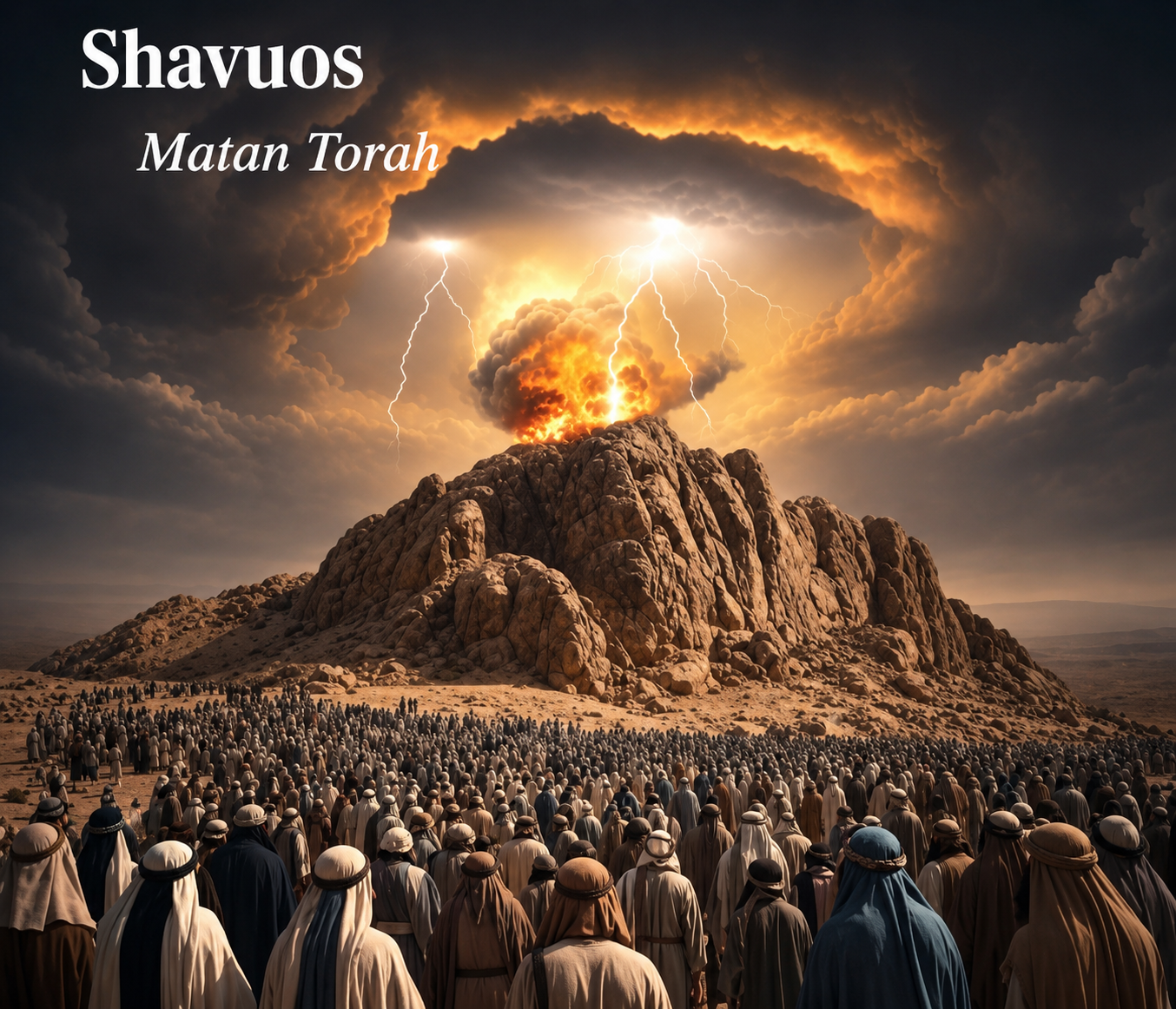
The word Shavuos translates as weeks, and follows the counting of the Omer. Seven weeks of preparation for Matan Torah.
Vayikra Perek 23: "You shall proclaim on this very day, a holy calling it shall be for you."
Shavuos, the time of the giving of the Torah. What could be more important to the Jews and Judaism than the giving and the receiving of the Torah?
Without Shavuos there would be no Torah, we would not be Jewish. There would simply be nothing.
Chazal and Kabbalah teach us that Shavuos is the moment of the eternal commitment between HaShem and the Jewish people. The Sefirah is a time for preparation, but also a time when trust and love grow deeper and stronger.
The celebrations of Shavuos take place in our shuls, starting with the Hallel, Tehillim, and the Akdamus glorifying HaShem. The Ten Utterances are read as a special reading of the day. The Yizkor is said on the second day.
The Megillas Ruth is read. To hear the Megillah on Shavuos has two reasons. First, the story takes place during the harvest of the barley, but more importantly Ruth, a Moabite woman, voluntarily chose to become Jewish.
Ruth was a Moabite princess who married the son of Naomi and Elimelech. After her husband died, she followed her mother-in-law to Eretz Yisroel and converted to Judaism. She married Boaz, and this is how she became the great-grandmother of Dovid HaMelech.
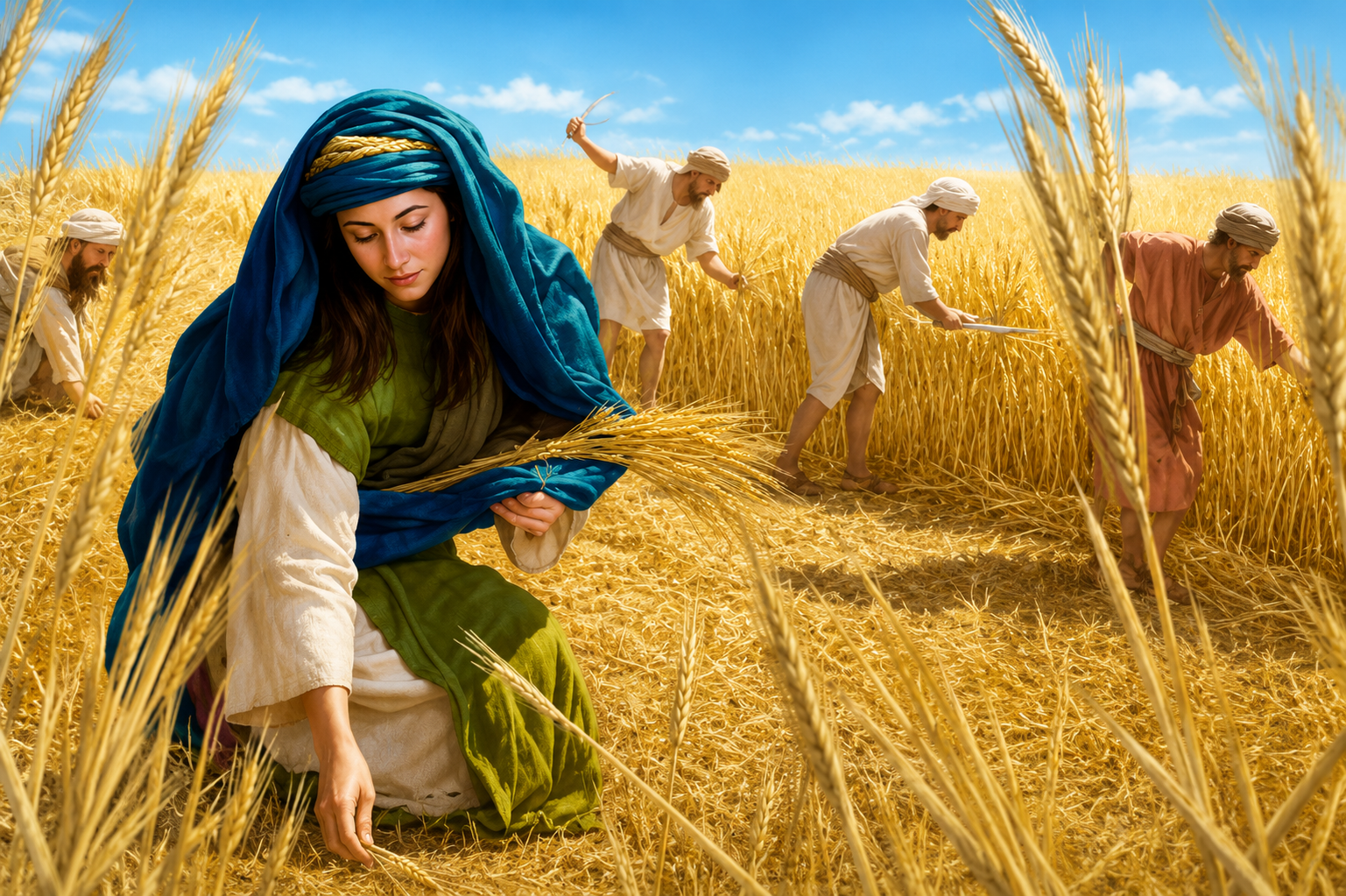
Ruth opposed the idol worship of her people, and when the opportunity came she happily gave up the privileges of royalty, left, and lived in poverty with the people she admired.
It was in the time of the Judges in Israel. The Jewish people became lax in their Torah observance, and called the consequences upon themselves, so there was famine in the land.
Elimelech lived at the time in Judah. He was a wealthy merchant, not used to poverty. He, together with Naomi and their two sons, packed up their belongings and went to live in Moab.
Ruth met the family, and learned about their traditions and Laws. She felt dissatisfaction with the idol worship of her people, and turned to something more positive and meaningful. When one of the sons, Mahlon, asked her to marry him, Ruth accepted with pride and happiness. Ruth never felt any regrets when she gave up the wealth and royal privilege she was used to.
She saw the differences between her people and the Jewish people.
When Elimelech and his two sons died, Naomi turned to her two daughters-in-law, and told them that they must leave, as she herself was going back to Beth-Lechem. Why would they suffer with her? Their husbands had both died, so Naomi advised them to go back home and find another husband. Orpah was sad, kissed Naomi, and returned home.
Ruth cried and begged her mother-in-law to allow her to go with her, not to send her away, and said: "For where you go, I will go; and where you lodge, I will lodge; your people shall be my people, and your G-D my G-D; where you die I will die, and there will I be buried; the L-RD do so to me, and more also, if anything but death will part you and me."
Naomi reminded her of the difficulties and challenges the Jews are confronted with all the time, but Ruth knew what she was doing. She was adamant and determined to follow her mother-in-law, to make the faith of the Jewish people her faith.
It was harvest time when Naomi and Ruth came to Judah. Both weary from the journey, Ruth told Naomi to rest while she would go into the field to find them something to eat.
Ruth entered the field where many men were cutting the barley, binding it into sheaves and piling them onto the wagons. Ruth hesitated, but the promise she made her mother-in-law made her go into the field. Suddenly she heard a voice, a kindly voice saying to her: "HaShem will be with you, stranger. Come into the field and get some corn to ease your hunger."
It was Boaz, the owner of the field. Ruth thanked him and went her way, when the same voice urged her to stay and gather some Pe'ah. Ruth asked him what Pe'ah was. The Torah tells us that when the owner of the field cuts his grain, he must not cut the corners of the field but leave them for the poor, or the stranger, to reap them, Boaz told her.
Expressing her gratitude, Ruth stayed and cut the corn from the corners of the field, and when she was about to leave, Boaz told her not to leave yet, and stay for the leket. Again Ruth asked what it meant. Boaz explained that leket was a law which meant that whatever they dropped they were not allowed to pick up, but had to leave for the poor and the stranger.
Ruth filled buckets full and thanked Boaz. Again Boaz urged her not to go yet, as she might benefit from the shikchah, which she could take. "What is shikchah?" Ruth asked. The owner of the field is taking his load of grains and may have forgotten some sheaves, and the Torah prohibited him from going back to get them. He must leave them in the field for the poor and the stranger, Boaz told her.
Ruth was happy with the food, it was almost too heavy to carry. She thanked Boaz, who asked her to come again. Naomi was happy when Ruth returned with the food and that Ruth found favour in the eyes of Boaz.
When Boaz asked Ruth to marry him, Naomi encouraged her to say yes. Ruth and Boaz were blessed with children, their first son was named Oved, who became the father of Yishai. They lived long enough to witness the birth of Dovid, the youngest son of Yishai, our beloved Dovid HaMelech.
The Megillas Ruth is read on Shavuos because her story is at the centre of the harvest. She mirrors the Jewish acceptance of the Torah by converting to Judaism.
Reading the Book of Ruth through the eyes of its most overlooked character.
The Megillah Ruth is also read in honor of Dovid HaMelech, whose yahrzeit falls on Shavuos. Through Ruth, the great-grandmother of Dovid HaMelech, we see the roots of the Davidic dynasty and the future promise of the Moshiach. This is one of the reasons why the Megillah has such a deep connection to Shavuos and why, during the Tikkun Leil Shavuos, the entire Book of Ruth is traditionally recited as part of the night of Torah learning and spiritual preparation.
Shavuos is not about accepting or reaccepting the Torah. The Ramchal explains that it is accepting the Torah on a whole new level. Accepting the Torah and living our life on a level of Torah truth.
In honour of Shavuos, "The Giving of the Torah," Chabad presented a list of 10 fundamental books that deserve a return to the spotlight.
The Torah is Love, it's Life, it's an eternal covenant between HaShem and the Jewish people.
A Holy and Living Torah, to study, to live, and to serve HaShem.
The Torah, the voice of heaven as it is heard on earth, the Word that gives light to the world.
The Torah is a Gift.
Kabolas HaTorah b’simcha ub’pnimiyus.
###
Elisheva bas Chana – Celebrating the Heart of Yiddishkeit
Elisheva is a passionate voice for authentic Jewish life, blending Torah wisdom, mitzvos, and the timeless beauty of Yiddishkeit. Her writing shines a light on the strength and grace of Jewish women—from the legacy of Devorah Leah, daughter of the Alter Rebbe, to today’s women who live with faith, modesty, and purpose. Through her words, Elisheva celebrates Torah study, family purity, and radiant tznius, inspiring readers to embrace the joy, depth, and enduring spirit of Jewish tradition. Contact Elisheva.
Comments
Comments are currently closed.