
Last night, throughout the Jewish world, we read מגילת רות (Megillat Rut, the Scroll of Ruth).
Many focus upon Ruth herself — the Moabite woman who attached herself not merely to a people, but to a covenant.
Others focus upon חסד (chesed, lovingkindness), loyalty, redemption, and the hidden hand of G-D moving quietly beneath ordinary human events.
Yet at the very end of the scroll, the narrative suddenly changes.
The poetry gives way to genealogy.
The story becomes names.
Ruth 4 closes with a chain:
Peretz (פרץ) begot Hezron (חצרון).
Hezron (חצרון) begot Ram (רם).
Ram (רם) begot Amminadav (עמינדב).
And onward until:
Yishai (ישי, Jesse) begot David (דוד).
At first glance, it appears almost administrative, as though the author merely wished to record ancestry for historical completeness. But Torah does not waste words, and certainly not at the climax of a sacred text read on Shavuot, the time of מתן תורה (Matan Torah, the Giving of the Torah).
The scroll ends not with romance, but with continuity.
Not with emotion, but transmission.
Not with Ruth’s tears in the fields of Bethlehem, but with the emergence of the Davidic line from which Jewish destiny itself would unfold.
And there, in the middle of that sacred chain, appears the name רם.
From רם to דוד המלך (David HaMelech, King David) are only a handful of generations.
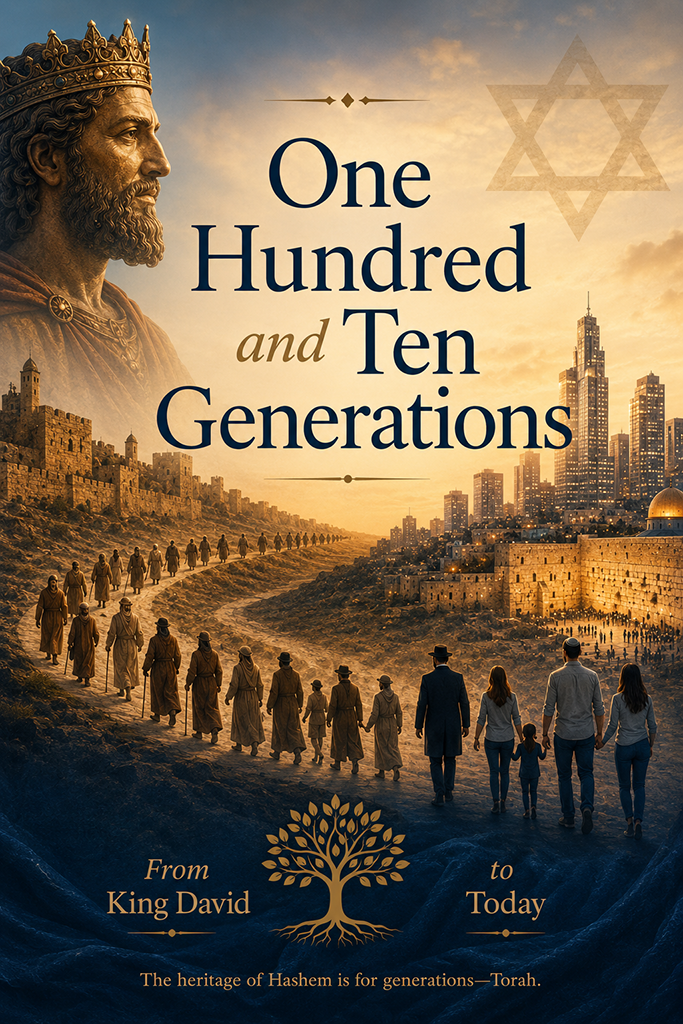
From דוד המלך to me today, however, are perhaps another 110 generations — an estimate, certainly, but a staggering thought nonetheless.
One hundred and ten generations.
One hundred and ten fathers and mothers.
One hundred and ten chains that did not break.
One hundred and ten eras of exile, wandering, persecution, survival, rebuilding, prayer, and stubborn refusal to disappear.
Empires rose and vanished during those generations.
Egypt faded.
Babylon fell.
Greece fractured.
Rome collapsed.
Kingdoms, flags, languages, currencies, and borders dissolved into history.
Yet the Jew remained.
Not because we were stronger.
Not because we were more numerous.
Not because history was kind to us.
But because each generation handed something to the next.
A language.
A covenant.
A prayer.
A scroll.
A memory.
A name.
Someone taught their child how to say שמע ישראל (Shema Yisrael, Hear O Israel).
Someone carried תפילין (Tefillin) across deserts and oceans.
Someone protected a siddur while fleeing a burning city.
Someone whispered Hebrew words in lands where Hebrew was forbidden.
Someone refused to let the chain end with them.
And that is perhaps the true meaning of the genealogy at the end of Megillat Rut.
The scroll is not merely telling us where דוד came from.
It is asking whether the chain will continue through us.
Because every Jew alive today is standing at the edge of that same sacred line.
We are not disconnected modern people reading ancient stories. We are the living continuation of them.
The same covenant carried through רם, through דוד המלך, through exile and return, through Shoah and rebirth, has now arrived in our hands.
And one day, if G-D wills it, another generation will look backward across another hundred generations and realise that we, too, were part of the chain that refused to break.
###
Bill White (Rami ben Ze'ev) is CEO of WireNews Limited, Mayside Partners Limited, MEADHANAN Agency, Kestrel Assets Limited, SpudsToGo Limited and Executive Director of Hebrew Synagogue
Comments
Comments are currently closed.