
Norway has published a report documenting what many Jews already knew: antisemitism has risen dramatically since October 7, 2023, and many Norwegian Jews no longer feel comfortable openly identifying as Jews.
The report, Jewish Life and Antisemitism in Norway, (published in Norwegian language, with an English summary) reveals that Jewish children experience exclusion at school, Jewish families increasingly conceal their identity, and members of Norway's tiny Jewish community feel isolated and vulnerable.
These findings are disturbing.
Yet the report's greatest value may not be what it says, but what it unintentionally reveals.
The report treats October 7 as a turning point. In one sense, it was. However, the suggestion that the atrocities of October 7 somehow caused antisemitism is deeply misleading. Hatred of Jews did not suddenly appear on October 8.
What changed was not the existence of antisemitism.
What changed was its social acceptability.
For decades, many Europeans understood that open hatred of Jews carried social consequences. One could privately harbour prejudice, but expressing it publicly was considered unacceptable. The massacre committed by Arab terrorists, from Gaza, on October 7 provided many people with what they believed was a moral licence to say openly what they had previously kept private.
The report itself points in this direction. Jews are not reporting disagreements about Israeli policy. They are reporting exclusion, intimidation, insecurity, and a desire to hide their Jewish identity.
Those are not signs of political disagreement.
They are signs of antisemitism.
A Norwegian Jew is no more responsible for decisions made by the Israeli government than a Norwegian Muslim is responsible for the actions of governments in the Arab world. Yet many people appear perfectly comfortable holding Jews collectively accountable for events occurring thousands of miles away.
That is one of the oldest forms of antisemitism in existence.
The report also suffers from a failure common to much contemporary reporting. It discusses the aftermath of October 7 without adequately recognising the significance of the atrocity itself.
The war in Gaza did not emerge from nowhere. It followed the largest mass murder of Jews since the Shoah. Entire families were slaughtered. Children were beheaded and murdered. Women and girls were raped. Civilians were kidnapped. Communities were devastated.
Yet in much of Europe, the massacre quickly faded from view while hostility toward Jews intensified.
That should concern everyone.
Norway's findings are also difficult to separate from the country's own history.
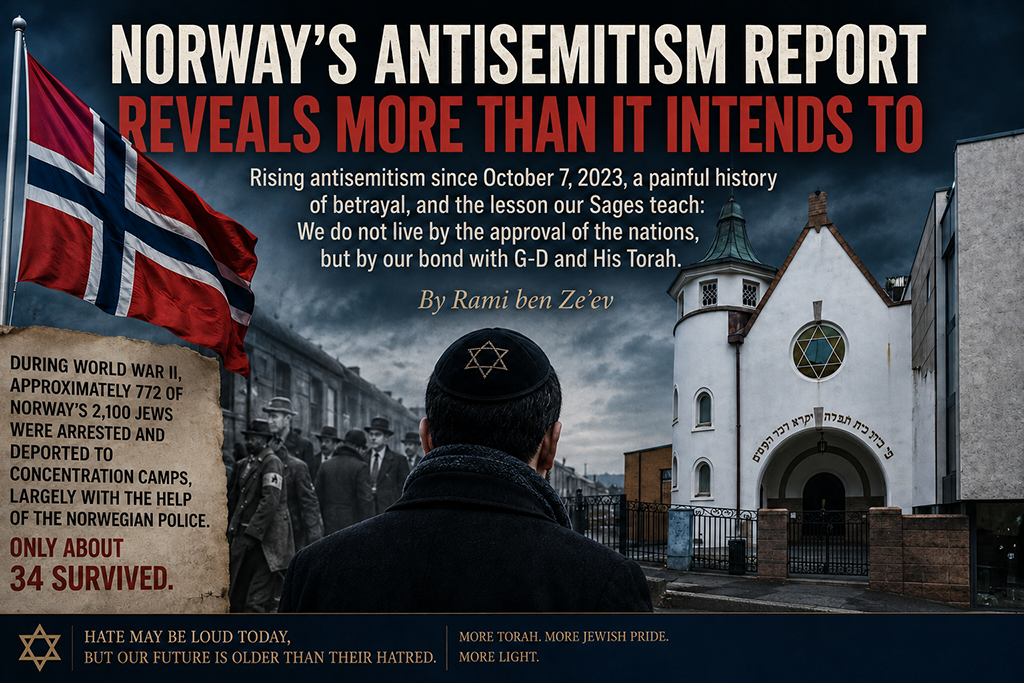
During the Shoah, approximately 772 of Norway's 2,100 Jews were arrested and deported to concentration camps, largely with the assistance of Norwegian authorities and police. Only around 34 survived. While many brave Norwegians risked their lives to save Jews, it remains an uncomfortable historical fact that the destruction of Norwegian Jewry was not carried out by Germans alone.
History does not repeat itself exactly, but it often rhymes.
When Jews begin concealing their identity, history teaches us to pay attention.
When Jewish children feel unsafe in school, history teaches us to pay attention.
When society increasingly tolerates anti-Jewish rhetoric, history teaches us to pay attention.
The report concludes that further efforts are needed to combat antisemitism. That is undoubtedly true. However, combating antisemitism requires more than additional programmes, committees, and government action plans.
It requires honesty.
It requires recognising that the problem is not simply ignorance. It is not merely misunderstanding. It is not solely the result of events in the Middle East.
The report documents something more troubling.
It documents that a significant number of people were willing to reveal attitudes that were already present beneath the surface.
For Norway's Jews, the message is sobering. They are one of the country's smallest minorities. When members of such a small community increasingly feel compelled to hide who they are, the warning signs should be impossible to ignore.
The question is not whether antisemitism exists in Norway.
The report answers that.
The real question is whether Norwegian society is willing to confront how deeply rooted that antisemitism may actually be, and whether it will do so before more Jews conclude that the safest way to live in Norway is not to live openly as Jews at all.
Yet there is another question that must be asked, one directed not at Norway but at all Jewish people everywhere.
How should Jews respond?
Our Sages did not teach us to become obsessed with those who hate us. They taught us to strengthen our connection to Torah, to one another, and to G-D. Hatred of Jews is not a new phenomenon. It has appeared in different lands, under different rulers, and under different names throughout history. What has preserved the Jewish people has never been the approval of the Nations, but our faithfulness to the covenant.
The lesson of this report is therefore not that Jews should hide. Nor is it that Jews should live in fear. Rather, it is that Jews must remain Jews.
When others seek to make Jewish identity invisible, the answer is not less Judaism but more Judaism.
More Torah study.
More observance.
More Jewish education.
More Jewish families.
More Jewish communities.
More pride in who we are.
Those who hate Jews should never become the centre of Jewish life. The centre of Jewish life must always remain the Torah itself.
Norway's report may reveal a troubling reality about the state of Norwegian society. For Jews, however, it should serve as a reminder of a truth far older than Norway itself: nations rise and fall, public opinion changes, and enemies come and go, but the Jewish people endure because our future does not depend upon the acceptance of man. It depends upon our relationship with G-D and our commitment to His Torah.
###
Bill White (Rami ben Ze'ev) is CEO of Jewish Dispatch Limited, Mayside Partners Limited, MEADHANAN Agency, Kestrel Assets Limited, SpudsToGo Limited and Executive Director of Hebrew Synagogue
Comments
Comments are currently closed.