
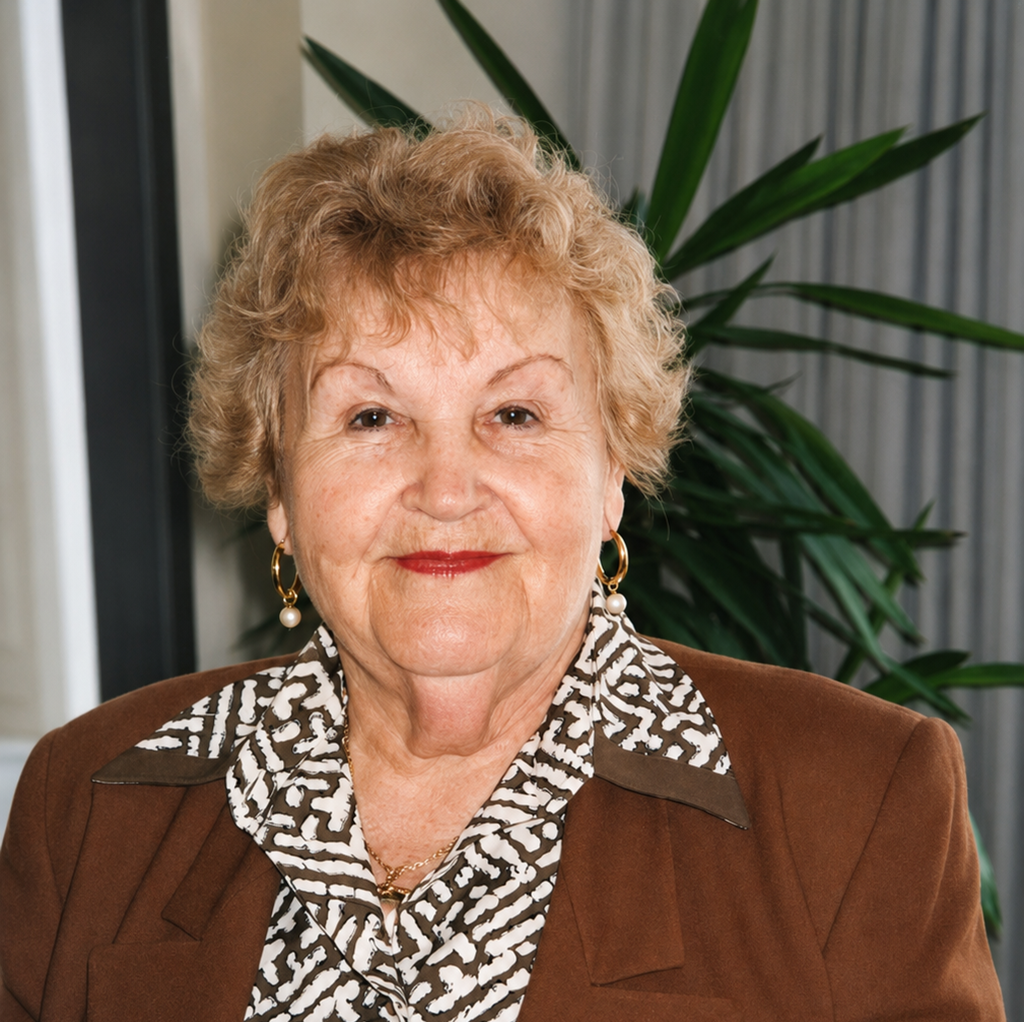
Luba Tryszynska-Frederick was one of those figures whose greatness emerged not from power, position, or recognition, but from a decision made in the middle of unimaginable darkness. Her story is extraordinary precisely because she was not a soldier, politician, or commander. She was a Jewish mother whose own child had been murdered, and yet she still chose to protect the children of others.
She was born in Poland in 1918 into a Jewish family during a period when Jewish life in Eastern Europe was vibrant but increasingly threatened by rising antisemitism. By the time Germany invaded Poland in 1939, the Nazi system of ghettos, deportations, forced labour, and extermination was already beginning to consume entire communities.
Luba eventually arrived in Auschwitz with her husband Hersch and their small son Isaac. The separation of mothers and children at Auschwitz was immediate and brutal. Young children were generally murdered shortly after arrival because the Nazis considered them “unfit for labour.” When Isaac was taken from her, Luba almost certainly understood, even if not immediately, what that meant.
Many survivors later described that moment — the loss of a child on the ramp — as the instant their previous life ended completely.
What makes Luba’s story remarkable is what happened afterward.
In Bergen-Belsen, conditions were catastrophic. Unlike Auschwitz, Bergen-Belsen was not primarily designed as an extermination camp with gas chambers, but by 1944–45 it had become a place of mass death through starvation, typhus, overcrowding, exposure, and neglect. Corpses often lay unburied. Food was almost nonexistent. Disease spread constantly.
In such conditions, caring for even oneself was difficult. Caring for dozens of children was almost impossible.
Yet Luba did exactly that.
The Dutch children she protected were part of a unique group. Many came from Jewish families connected to the Dutch diamond industry. Some of these Jews had initially received slightly different treatment because Germany valued diamond workers economically. But by late in the war, even those distinctions collapsed, and the children became vulnerable and abandoned inside the machinery of deportation and death.
The extraordinary part of Luba’s actions is not merely that she fed them.
It is that she created order, emotional safety, and maternal presence inside chaos.
Children in camps often died not only from hunger but from terror, exposure, confusion, and despair. A calm adult voice, instructions, washing, shared food, enforced quiet, and physical closeness could literally mean survival.
When she told the children to remain silent, she was not being harsh. She understood the psychology of survival inside the camps. Noise could attract guards. Panic could spread instantly. Fear could become deadly.
Her motherhood became communal rather than biological.
This is one of the deepest aspects of her story.
After the Shoah, many survivors spoke about the destruction not only of bodies, but of the natural structure of family itself. Parents lost children. Children lost parents. Entire bloodlines disappeared. In Luba’s case, the instinct of motherhood survived even after the murder of her own son.
“I gave them my love because I had lost my own son” is one of the most devastating and profound statements to come out of the survivor testimony of the Shoah.
She did not surrender her identity to grief.
She redirected it toward life.
That is why the surviving children later called her the “Angel of Belsen.” Not because she was unreal or saintly in some mythological sense, but because in a place deliberately engineered to erase human compassion, she behaved like a human being anyway.
The reunion in Amsterdam in 1995 was especially powerful because many survivors of the Shoah spent decades believing they were alone. Many did not speak publicly about their experiences until very late in life. Trauma silenced enormous numbers of survivors.
For those children — by then elderly adults themselves — returning to thank Luba was not merely an act of gratitude. It was a declaration that her actions had echoed across generations.
Every child she saved potentially became a family line restored.
Children.
Grandchildren.
Great-grandchildren.
Entire futures that the Nazis intended to erase.
In Jewish thought, this carries enormous weight. The teaching from the Mishnah in Sanhedrin that “whoever saves one life, it is as if he saved an entire world” is often quoted, but stories like Luba’s reveal what that truly means. She did not merely preserve biological survival. She preserved continuity.
Her story also stands as a reminder that heroism during the Shoah was often quiet, hidden, and maternal rather than military. Some fought with weapons. Others fought by sharing crusts of bread, hiding children, cleaning wounds, comforting the terrified, or opening a barracks door when closing it would have been safer.
Luba died in the United States in 2009 at the age of 91. The Nazis murdered her son and tried to erase countless Jewish children from the world, yet because she chose compassion over despair, dozens survived and generations followed them.
Luba Tryszynska-Frederick belongs among those whose resistance took the form of refusing to allow humanity itself to die.
###
Bill White (Rami ben Ze'ev) is CEO of WireNews Limited, Mayside Partners Limited, MEADHANAN Agency, Kestrel Assets Limited, SpudsToGo Limited and Executive Director of Hebrew Synagogue
Comments
Comments are currently closed.